Plan Your Trip
Plan a Hike Without a Car
Connect transport, the trailhead approach, the walking route, and a verified return without relying on the last bus.
On this page
Start with the journey home. A trail that looks straightforward on a map can become an unsuitable first outing when the only return bus leaves before you can realistically reach it. Planning without a car means connecting several separate systems: public transport, the path from the stop to the trailhead, the walking route, and the return connection. None of those links should depend on an unexplained assumption.
This guide helps you assemble that chain. It does not provide a timetable or promise that a taxi, rideshare, or mobile signal will be available. Use current information from the actual operator and land manager, including service notices for your travel date.
Draw the whole journey, including the missing walk
Write the route as a sequence of named places: departure station, interchange, arrival stop, trail entrance, walking destination, return stop, and homeward service. A transport app may label a stop with a park's name even when the entrance is elsewhere. Check the stop's exact location and the permitted pedestrian connection.
Study the connection as carefully as the hike. Look for a footpath, crossing, gate, private access, or road segment that could affect your group. A short distance along a fast road without a suitable pedestrian route can be a reason to reject the plan. Do not assume that the verge is a walking path because an app draws a line there. If official information does not settle a consequential access question, ask the manager or operator before traveling.
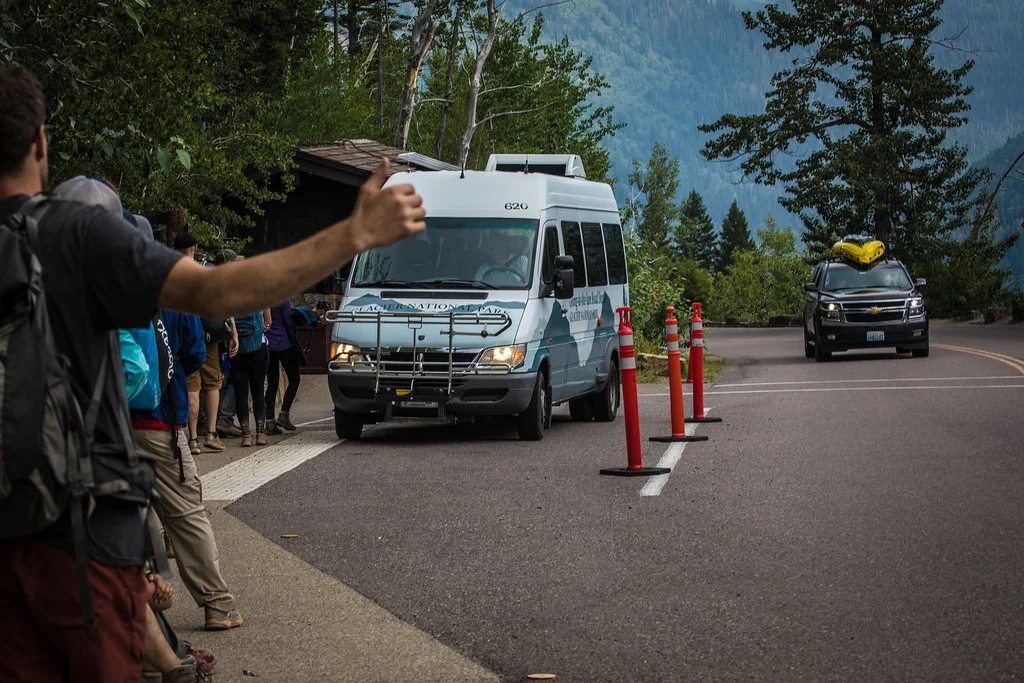
Account for what you carry through stations and interchanges. A bulky camping load, mobility aid, dog, or child carrier can affect boarding, storage, and access. Check the operator's applicable rules and accessibility information. A photograph of a bus does not establish which vehicle or boarding arrangement will be available on your date.
Read each service in the direction you need
Check the service date, day of week, direction, stop sequence, reservation rules, and any seasonal suspension. The final departure from the first stop is not necessarily the time it reaches your return stop. Some services run in one direction around a loop, and a stop used on arrival may not serve the return you expect.
Treat a park shuttle and a regional bus as different links until you confirm otherwise. The National Park Service's Rocky Mountain transport page illustrates why: it distinguishes internal routes from connections outside the park. Use that page as an example of questions to ask, not as a schedule for another destination. A service being described as free also does not establish park entry permission, a reserved place, or an onward connection.
Save the relevant official timetable and service notice offline. Include the stop names and operator contact details, not just a screenshot of one departure. Recheck before leaving home and again when practical before starting the walk.
Build a return window instead of targeting the last vehicle
Work backward from a suitable homeward departure. Include the walk to the stop, any boarding requirement, the walking return, ordinary pauses, and a separate allowance for uncertainty. Keep the allowance visible rather than hiding it inside a fast pace estimate.
Fictional scheduling exercise: A walker identifies departures at 16:00 and 17:00. Their preferred plan reaches the correct stop by 15:30; the later service is a contingency, provided it is confirmed to operate. They do not start with “we can always catch 17:00” and spend the entire margin on an optional viewpoint. These times are invented to demonstrate the distinction, not recommended allowances.
If only one return exists, decide whether the outing is appropriate at all. A reservation may protect a seat but cannot make the group reach the stop on time. Choose a shorter verified route or another date when the chain has too little flexibility.
Test the backup against the same failure
| Assumed backup | What you must verify | If it remains uncertain |
|---|---|---|
| A later bus | It serves the right stop and direction on this date | Do not count it as an available return |
| A taxi or rideshare | Actual coverage, pickup access, booking conditions, and communication | Arrange a confirmed option or simplify the outing |
| Walking to another station | A permitted, manageable pedestrian route with enough daylight | Avoid inventing a road walk after missing transport |
| Staying overnight | Authorized accommodation, availability, and suitable equipment | Do not treat an unplanned camp as automatic permission |
An alternative that uses the same closed road or canceled transport corridor may share the original failure. Ask what changes if weather disrupts both the hiking plan and the service. Missing a bus is not itself a reason to call emergency services; being injured, in danger, or unable to return safely requires the appropriate local response.
Carry the transport plan into the walking decisions
Put the stop, direction, intended return, fallback, and check-in arrangement in your shared trip plan. Give the contact the entire journey rather than only the trail name. Keep enough phone power for the tasks you expect, while retaining navigation that does not depend on reception.
At your agreed turnaround point, compare the actual return demands with the transport window. Shorten the walk before the connection becomes a race. If you change the return arrangement, inform the contact where possible and confirm the new plan rather than silently editing your own notes.
Afterward, record the connection that was hardest to understand. A mislabeled stop, longer approach, or confusing direction is a concrete improvement for the next trip. Keep that observation dated: it is useful experience, not evidence that the same service will operate next season.
FURTHER READING
Sources and scope
References below explain the underlying guidance; FIELDLIGHT comparison tables, worked examples, and worksheets are editorial planning aids. Hypothetical examples are not field tests. Check the current local authority for your trip.
- Shuttle Buses and Public TransitU.S. National Park Service
Rocky Mountain National Park example only. Timetables change; check the actual operator for the travel date.
- Trip Planning GuideU.S. National Park Service
US national park context; use the workflow as an example and direct visitors to their local land manager.
TAKE THE NEXT STEP